By Ben Harden
Updated August 8, 2026 – 8:40am; first published 8:30am
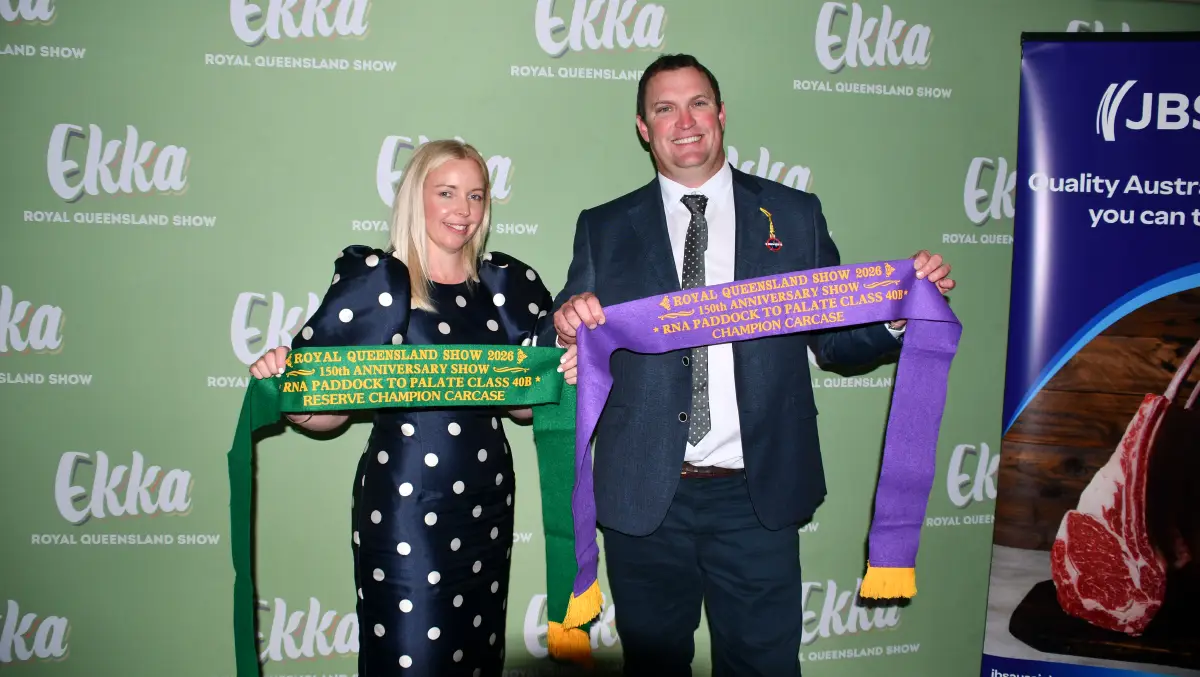
Nicole and Guy Campbell, Campbell Family Trust, Condamine, were among the top winners at this year’s RNA Paddock to Palate competition. Picture by Ben Harden.
Western Downs commercial beef producers, the Campbell family is doubling down on its Angus breeding program after claiming their first grand champion carcase title in this year’s RNA Paddock to Palate beef competition.
Competing in the event for the past 12 years, the Condamine family entered two pens of Angus steers in the class 40b HGP-free export, 120-day fed competition, outperforming some of Australia’s leading stud operations to claim both champion and reserve champion individual carcase honours.
Their grand champion Angus steer achieved an average daily gain of 1.64 kilograms, producing a 345kg hot standard carcase with a dressing percentage of 54.94 per cent. The steer measured 19mm P8 fat, 7mm rib fat, an eye muscle area of 112 square centimetres and a marble score of two, resulting in an MSA index of 61.56 and a total of 97 carcase points.
The reserve champion steer was similarly impressive, recording a 339kg hot standard carcase, a dressing percentage of 53.64 per cent, P8 fat of 14mm, rib fat of 9mm and an eye muscle area of 101sq cm.
The Campbell Family Trust runs about 1200 Angus breeders and 70 bulls, targeting high intramuscular fat genetics for the feedlot market and producing steers to suit the 400–420kg feeder market.
Guy Campbell manages the operation on behalf of his parents John and Barbara Campbell, and said the result confirmed the family’s breeding direction.
“We run an EU-accredited, HGP-free program at the moment. We believe there’s a bit of benefit in that through premium markets with our Angus,” Mr Campbell said.
“We’re 100 per cent Angus now and we try to aim for high performance for the feedlotters with high IMF.”
He said producing cattle that deliver returns for feedlot customers remained the priority.
“We’ve got to start putting up the best genetics and the best cattle to help them make money, which in turn hopefully down the track helps us make money.”
The competition also served as an important benchmarking exercise after the family reintroduced Angus into the breeding program.
“Last year was our first year back with the Angus, and we pretty much did that to really get some benchmarking done on our own cattle,” Mr Campbell said.
To compare bloodlines, the Campbells entered one pen carrying genetics from a recently purchased Rennylea Angus female herd and another featuring their established Angus genetics.
“In the end, our Rennylea genetics won grand champion carcase, and then reserve champion was our regular breeding,” he said.
The Rennylea females were purchased during the family’s post-drought rebuild.
“About four years ago, we started buying in after the 2019 drought. We had to rebuild our herd and restock.”
Mr Campbell said the southern genetics had delivered the performance they were seeking.
Despite ongoing dry conditions, he said strong feeder cattle prices had been encouraging.
“We’re really impressed with the way the prices of the cattle have held up this year.”
The family now plans to continue expanding the herd while refining its genetic program.
“The next thing for our operation is trying to expand the herd. We’re probably still 300 breeders short of where we want to be, so we’d like to get to that 1500-head mark down the track.”
Temperament and structural soundness are also major selection priorities.
“Since going to Angus, we’ve realised the temperament of the breed is so much safer in the yards, easier to truck and easier to manage. We do cull a lot on temperament.”
For Mr Campbell, the result represented years of work coming together.
“After years of dedication, I was really proud of winning this class because it had become a goal of mine.
“When our names got called out for reserve champion and grand champion in the non-HGP class, it was an unbelievable feeling that we’re on the right track.”
HGP-free export winners
The overall winner of the HGP-free export, 120-day fed class was Ben and Gemma Noller and Simon and Myriam Daley of Palgrove Charolais Pty Ltd with their Charolais-cross pen.
Their pen of seven averaged a 346.5kg carcase weight, a dressing percentage of 54.73 per cent, P8 fat depth of 13.29mm, rib fat depth of 10.43mm, an eye muscle area of 91.43sq cm and an MSA index of 62.96.